Circular economy is increasingly recognized as a key driver of innovation across modern industries, and wind energy is no exception. With the first turbine-generation reaching end-oflife, sustainable recycling of rotor blades and their components has become a pressing challenge. Blades are mainly made of fiber-reinforced plastics (FRP), laminates of a polymer matrix and reinforcing fibers, which offer low weight, high strength, and long service life but pose significant end-of-life recycling issues. Same applies to the production residues (scrap, offcuts etc.) which account for up to 30% of total product weight [1]. Legal restrictions on landfilling, recycling quotas, and CO₂ reduction targets further urgency for effective recycling strategies [2,3].
Since the recycling of FRPs based on epoxy resins at end-of-life is still not state of the art, recyclability would be an excellent addition to the proven operating properties of FRP components in the modern wind power industry.
Conventional epoxy-based FRPs are difficult to recycle due to dense cross-linking and strong fiber adhesion. As epoxy resins dominate turbine blade production, valuable fibers and resins remain largely unrecoverable. Current recycling methods, including mechanical, thermal and chemical recycling or even landfilling, are environmentally harmful and increasingly restricted by regulations [2,3], highlighting the need for new systems that combine high performance with sustainability.
An innovative solution are cleavable epoxy resins, such as Recyclamine®, that enable controlled separation of matrix and fibers from decommissioned blades [4-6]. This allows recovery of high-quality fibers and produces a matrix recyclate with thermoplastic-like properties. Recyclable resins achieve mechanical performance comparable to conventional epoxies [5-7], supporting repeated reuse and reducing environmentally harmful disposal.
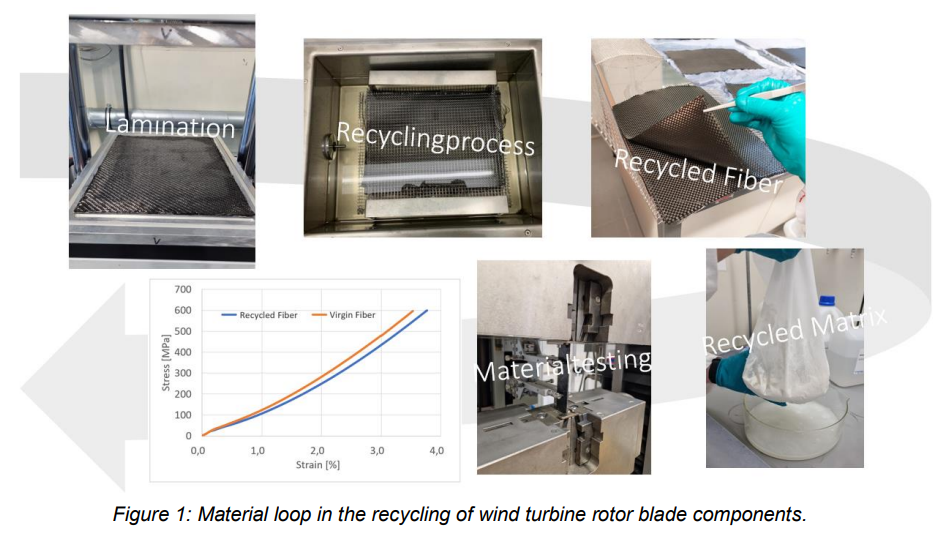
This paper explores prospects for the implementation of recyclable resin systems in the manufacture of CFRP components for rotor blades, being based on a comparative material-analysis with conventional resin systems and the corresponding recyclates. Firstly, the paper outlines cleavable resin technology. CFRP flat profiles made with Recyclamine® 301, representing rotor blade outer skins, serve as test specimens. Furthermore the developed device for laminating profiles via wet pressing is described. Additionally, a method was developed that allows gentle separation of the matrix and fibers and is expected to preserve the mechanical properties of the fibers. The core of the paper deals with destructive material testing. The potential of recyclable CFRP laminates and the recyclates obtained from them is discussed in conclusion on the basis of tensile tests results. Samples from conventional, recyclable, and n-times recycled CFRP laminates are compared.
References
[1] Fraunhofer Institute for Production Technology IPT: More Sustainability for Carbon Components: Recycling Production Waste from CFRP Tapes. Press release, accessed 6 September 2025. Available at: https://www.ipt.fraunhofer.de/de/presse/Pressemitteilungen/nachhaltigkeit-fuer-carbon-bauteile-produktionsreste-von-cfk-tapes-wiederverwerten.html
[2] German Environment Agency (Umweltbundesamt): Fiber-Reinforced Composites: Future Material with Open Disposal. Website, accessed 9 September 2025. Available at: https://www.umweltbundesamt.de/faserverbundwerkstoffe-zukunftsmaterial-offener#faserverbundwerkstoffe-und-ihr-potenzial-fur-klima-und-ressourcenschonung
[3] Federal Ministry of Justice and Consumer Protection: Regulation on Landfills and Long-Term Storage (Landfill Ordinance – DepV) (2024). Accessed 9 September 2025. Available at: https://www.gesetze-iminternet.de/depv_2009/BJNR090010009.html
[4] Sakai, A.; Kurniawan, W.; Kubouchi M.: Recycled Carbon Fibers with Improved Physical Properties Recovered from CFRP by Nitric Acid. Applied Sciences, vol. 13 (2023). doi: 10.3390/app13063957
[5] Taheri, F.; Chowdhury, S. A.; Ghiaskar, A.: Comparison of the Performance of Basalt Fiber-Reinforced Composites Incorporating a Recyclable and a Conventional Epoxy Resin. Polymers, vol. 17 (2025). doi: 10.3390/polym17101348.
[6] Dubey, P. K.; Satish, K.M.; Dixit, A.; Changmongkol, S.: Recyclable epoxy systems for rotor blades. IOP Conf. Ser.: Materials Sciences and Engineering (2020). doi:10.1088/1757-899X/942/1/012014
[7] Aditya Birla Chemicals: Recyclamine – A Revolutionary Platform Chemistry to Enable Recyclable Thermosets. Aditya Birla Chemicals Website, accessed 9 September 2025. Available at: https://www.adityabirlachemicals.com/brand/recyclamine