The recycling of batteries is currently based on pyro- or hydrometallurgical processes that are energy and chemical-intensive. [1] Therefore, novel strategies using electrochemical methods are investigated. By in situ generation of leaching reagents the need for chemicals can be minimized and the handling of dangerous substances like hydrogen peroxide is avoidable. The separation of extracted metals requires several complex steps that need additional chemicals for solvent extraction, stripping and precipitation. Thus, using electrowinning for the recovery and separation of metals is an alternative. As sustainable leaching reagent peroxydisulfate was generated in situ from sulfuric acid on borondoped diamond electrodes. This solution was used for ex-cell leaching of battery cathode materials like lithium cobalt oxide (LCO) and lithium nickel cobalt manganese oxide (NCM) as well as industrial black mass. The leaching rate is increased by up to 100 % for LCO and NCM compared to not electrolyzed solutions and a substantially faster conversion rate is observed for black mass with full extraction of all metallic components. [2]
Mechanistic studies revealed that hydrogen peroxide is formed in situ from persulfate and is responsible for the improved reactivity. To further improve the method, a flow cell setup was designed to use currents up to 4 A to generate 1 M persulfate concentrations.
In addition, we investigated the electrowinning and separation of cobalt and nickel from solution. By using varying conditions (pH, temperature, potential) a controlled low reduction potential was most beneficial for a high selectivity reaching over 90 % cobalt content. The use of organic additives further increased the cobalt selectivity up to 98 %.
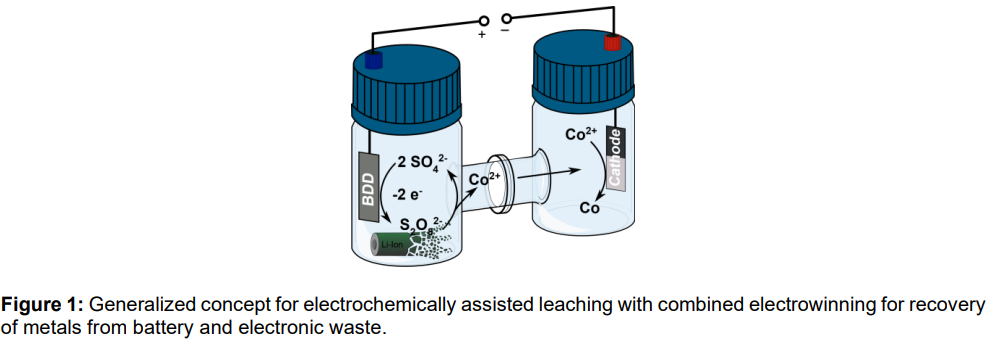
This concept of coupled electrochemical leaching and electrowinning is schematically shown in Fig.1. A similar system was also used for the recovery of silver and copper from photovoltaic waste with high recovery rates underlining the versatility of the approach. [3]
References
[1] Velázquez-Martínez, Valio, Santasalo-Aarnio, Reuter, Serna-Guerrero, Batteries 2019, 5, 68.
[2] M. M. Pradja, C. Modrzynski, ACS Sustain. Chem. Eng. 2025, 13, 16805–16815.
[3] C. Modrzynski, L. Blaesing, S. Hippmann, M. Bertau, J. Z. Bloh, C. Weidlich, Chem. Ing. Tech. 2021, 93, 1851–1858.