Modern business practice in general emphasises the social dimension equally as the environmental one (Sutherland, Richter et al. 2016). The social sustainability interplays with much needed transitions to a circular economy (CE) according to the European Commission’s vision for a clean planet. A few scientific publications overviewed the social sustainability for manufacturing; for instance, Ref. (Sutherland, Richter et al. 2016) showed relevant national-level indicators as well as stakeholders and indicators for manufacturers. For the enterprise level, relevant indicators are further developed (e.g., Ref. (Hutchins, Richter et al. 2019)). However, research on the social sustainability is underdeveloped compared to that on environmental sustainability for manufacturing and in the context of a CE (Alvarez and Ligthart 2021, Valencia, Bocken et al. 2023).
This conference contribution aims to highlight the social sustainability of a product-as-a-service (PaaS) as a category of circular business models. It presents a case study of social sustainability assessment of a PaaS offering with household goods for a CE, and thereby discusses its potential impacts on the social sustainability. The assessment method used is social LCA (UNEP 2020, UNEP 2021). The materials were collected from the PaaS providing company (BSH home appliance) as well as relevant websites and scientific literature on PaaS.
The case study results will first explain the PaaS offering that BSH practices in Belgium since 2018, under the name of Papillon, targeting families living in poverty that cannot afford to purchase energy-efficient home appliance. BSH established a partnership with a social enterprise whose mission is to help socially vulnerable people. This constellation enables the end users to use energy-efficient home appliance leading to lower energy bills through rental contracts with affordable monthly flat payment; see Fig. 1. The rental contracts run for a period of 10 years with a monthly rental fee of about 9 € per device.
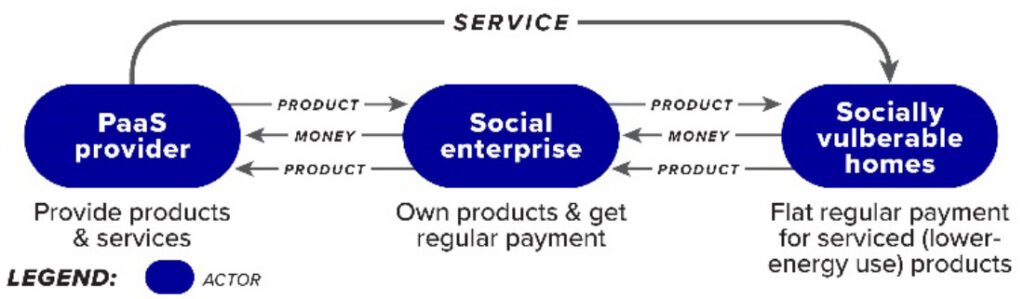
Fig. 1: Three actors with flows of products and money involved in the case PaaS offering (Sakao, Bocken et al. 2024)
The paper will show the potential impacts on the social sustainability of this PaaS offering. For instance, consumers benefit from improved product performance and safety standards under the PaaS offering; however, possible concerns exist regarding consumer privacy, impacting consumer integrity. Discussions will be presented for key aspects to be addressed in designing such a circular business model, including a double systems perspective proposed by (Sakao, Bocken et al. 2024) regarding the product lifecycle and value network perspectives.