Lithium-ion battery (LIB) modules have significant capacity left (typically more than 80%) at the end of their useful life in electric vehicles (EVs). These modules can be repurposed for secondary, less-demanding applications. We conducted an empirical study on the accelerated assessment of the remaining capacity of used EV-LIB modules in the context of an unknown state-of-charge (SOC). The objective was to estimate the state-of-health (SOH) in the form of the percent capacity fade of individual modules relative to the initial, nominal capacity. The target accuracy of a few percent was sufficient to avoid expensive, full-cycle testing of severely degraded modules. The transient-response waveforms associated with pulse-charge waveforms provided data for fitting the phenomenological equivalent-circuit model (ECM). Module characterization for typical aged-related aging consisted of multiple cycles of constant-current (CC) constant-voltage (CV) discharges, followed by 10-min-on-10-min-off pulse charges. The model parameters, viz., open-circuit voltage, input impedance, and polarization capacitance-resistance pairs, depend on both SOC and SOH, and it was critical to disambiguate the two dependencies. LIB modules of different cathode chemistries required separate characterization of the ECM parameters. We trained machine-learning models using the estimated ECM parameters as features and SOC and SOH as targets. To attain realistic model performance, the separation between training and validation data was physics-based: the training dataset employed data associated with a subset of modules, and the validation dataset contained the data from the remaining modules. The initial results for both lithium-ironphosphate (LFP) and nickel-cobalt-manganese (NCM) chemistries indicated that the target performance was attained, with SOH estimation error ≤ ±5% on validation data. The investigation paid close attention to detecting prior electrical abuse in the form of overcharge and over-discharge. A separate set of cell-level experiments generated battery abuse data by subjecting cells to progressive overcharges and over-discharges. The first results suggested that the increase in the internal impedance exceeds the variance of impedances of the associated moderately degraded modules.
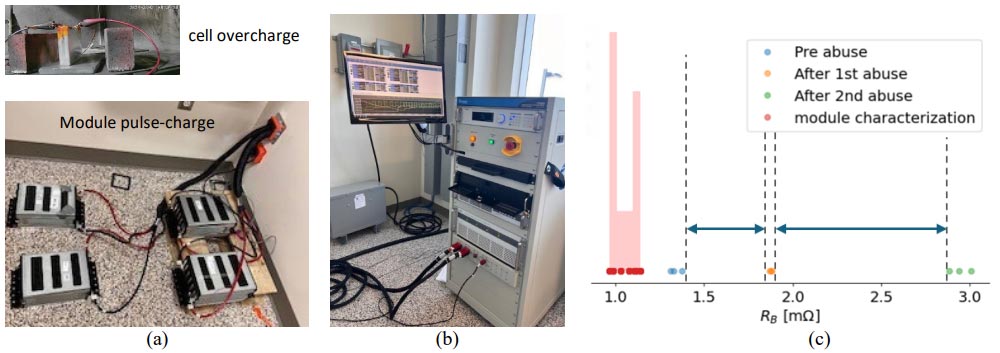
Figure: (a) cell and modules under test (b) module tester (c) detection of over-charge abuse.