As the world prepares for the use of Artificial Intelligence “AI” at scale, the demand for data centers and power generation reliability grows with it. Energy security relies on the maintenance, repair, and overhaul “MRO” of turbine bearings and blades. A review of the manufacturing techniques employed for MRO in this field shows a lengthy workflow involving many steps and a large amount of metal waste, including metals that are increasingly difficult to obtain due to the evolving geopolitics. A key reason for the waste of metal is the lack of insight into the quality of the metal condition before and in between typical repair steps.
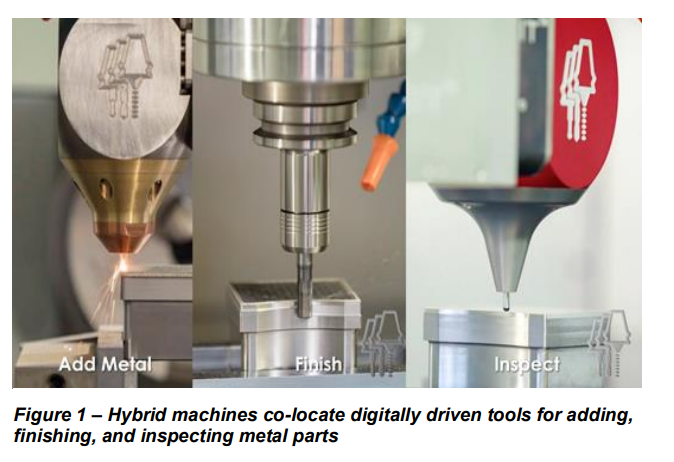 The growth of the “hybrid manufacturing” market which combines additive, subtractive, and inspection technologies in one machine as shown in Figure 1, enables interrogation of the metal condition before and immediately after each repair operation. This provides a practical means of ensuring quality remanufacturing with only a minimum amount of new metal consumption.
This work will review the state-of-the-art in hybrid machines and the maturity and market acceptance achieved thus far. It will include specific case study data using hybrid machines to repair critical bearing surfaces for energy generation equipment. The quantified savings in energy, cost, and the reduction of metal consumed during the repair process will be reviewed.
This work will also highlight how the efficiencies demonstrated in the above context can help make related repairs of metal parts practical for the first time. The new levels of data captured about individual parts during the remanufacturing process also point towards another type of circular energy use in which the energy saved during repair can power AI analysis of the captured data to distill appropriate insights to improve energy savings further.