Only a small fraction of the plastics produced are being recycled, with the great majority landfilled or released into the environment. Mechanical recycling is currently used to recycle plastic, however, this method is efficient only for homogeneous and non-contaminated feedstock, and for easily identifiable objects such as bottles made of PET or HDPE. Polyolefins in the plastic waste stream can be processed via pyrolysis, the most common among chemical recycling processes. Pyrolysis, however, decomposes the polymers, resulting in undesirable greenhouse gas (GHG) emissions. Further, pyrolysis is not viewed as constituting recycling when its product, pyrolysis oil, is not converted into new polymers.
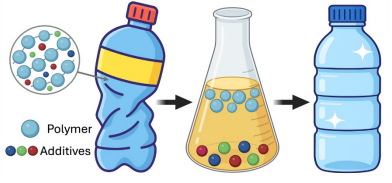
Plastics recycling research in our group utilizes physical, solvent-based processes that do not break down the polymer chains. This constitutes true recycling, as the recovered polymer is the same as the starting material. Such molecular recycling processes leave the polymer chains intact, thus maintaining their embodied energy and emitting relatively little GHG.
This presentation addresses the mechanism of semicrystalline polyolefin dissolution as revealed through joint in-situ infrared spectroscopy experiments and diffusion kinetics modeling. The presentation also highlights the application for polyolefin recovery of switchable hydrophilicity solvents (SHS) that can cycle between a form that dissolves the target polymer and a form that does not, hence facilitating closedloop solvent cycling.
The insights obtained from these studies facilitate the design of solvent systems and processing conditions for the molecular recycling of polyolefins via dissolution-precipitation. Dissolution-precipitation is an energy-efficient and environment-friendly recycling process that can recover specific polymer types from mixtures, blends, or multilayer films, and purify them from additives, without negatively affecting the properties of the original polymers.
Acknowledgements:
This material is based upon work supported by the National Science Foundation (NSF) under Grant No. EFMA-2029375 “EFRI E3P: Valorization of Plastic Waste via Advanced Separation and Processing”.
