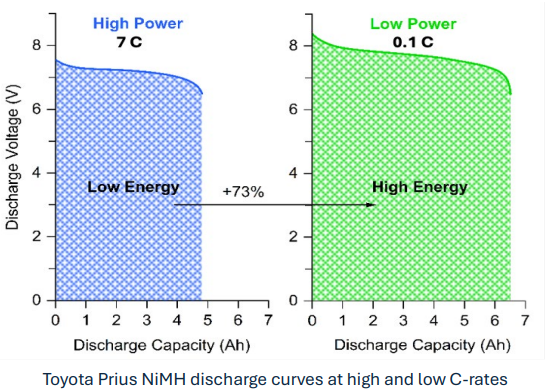
Puerto Rico has an abundance of nickel–metal hydride (NiMH) batteries approaching the end of their service life as traction batteries. We have demonstrated that these batteries can be repurposed as stationary energy storage systems when operated at substantially lower C-rates. Data derived from Prius battery modules illustrate the thermodynamic advantage of operating at reduced discharge power: lowering the C-rate from 7 C to 0.1 C increases the available non-expansion work by 73%. To validate this concept, we reconfigured 100 Toyota modules for use in a low-income home in Utuado, Puerto Rico, where typical household energy storage requirements are 5 kWh or less. The reconfigured battery pack was integrated with solar panels to provide a sustainable power source. This work presents both the thermodynamic framework and a schematic for a holistic circular battery economy—one that engages low-income families directly in the processes of reuse, remanufacturing, recovery, and recycling to establish a sustainable energy lifecycle for Puerto Rico. From a thermodynamic standpoint, we extend the application of Peukert’s law to predict mid-point (average) voltages and amp-hour capacities, enabling projection of the total available non-expansion work as C-rates are reduced. This extended Peukert law methodology is also applicable to lithium-ion and lithium-iron-phosphate battery systems.