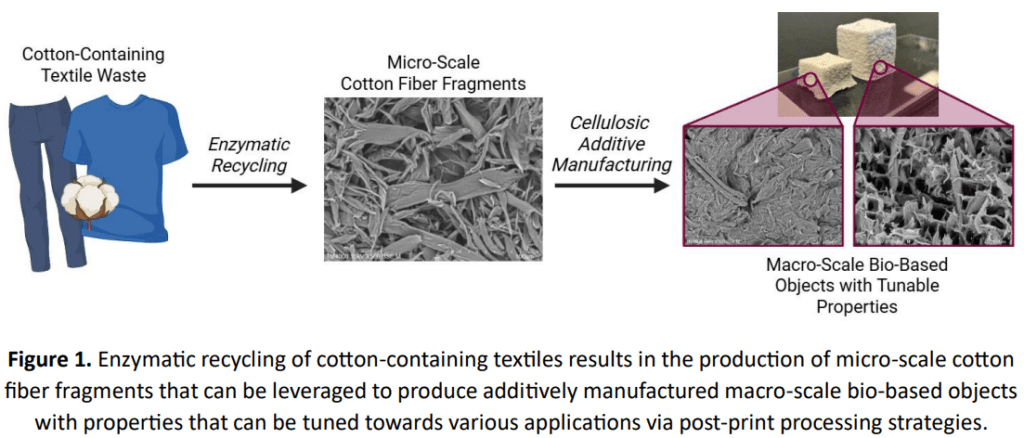
Apparel waste management is a global challenge that is becoming increasingly dire with the rise of fast fashion supply chain models, resulting in the projected accumulation of gigatons of textile waste in the world’s landfills by 2040. Moving towards textile circularity would divert waste from landfills, reduce dependence on carbon- and resource-intensive virgin materials, and serve as an opportunity for important value retention of these highly engineered materials. However, textile recycling is challenging due to the difficulty of separating complicated apparel products and fiber blends into useful waste streams. Enzymes present a potential solution because, together with simple filtration, they are adept at separating fiber blends (unlike mechanical recycling techniques such as shredding) due to their substrate selectivity (i.e. extracting cotton fragments form a cotton/polyester blend while leaving the polyester intact). NCSU’s Textile Biocatalysis Research group has developed an enzyme-mediated process to efficiently degrade the cotton components of model apparel materials into slurries of micro-scale cotton fiber fragments (CFFs) and soluble sugars under mild reaction conditions. In addition to attractive cellulose attributes such as biodegradability, thermomechanical stability, and readily modified chemical functionality, the residual CFFs are highly crystalline and have dimensions that are suitable for the development of bio-based additive manufacturing feedstocks. The focus of this research is the reassembly of these enzymatically degraded micro-scale fragments into industrially relevant, bio-based macro-scale objects (such as structural meshes and grids for apparel, footwear, and home furnishings) via 3D printing. Rather than disrupting the CFF crystallinity via harsh dissolution procedures, as occurs during the production of viscose or lyocell, the fragments will be suspended in extrudable liquid media, with minimal added compounds in alignment with green chemistry principles, and then coalesced to achieve structural integrity. Initial prototypes have shown both the feasibility of the CFFs as an additive manufacturing feedstock material, as well as their potential industrial versatility by modifying feedstock formulation and post-print processing conditions towards diverse, application-specific final object properties. The fabrication of proof-of-concept cellulosic bioink printed prototypes will serve to demonstrate a potential pathway for commercial valorization of the waste cotton fiber fragments and incentivize industrial textile waste recycling.