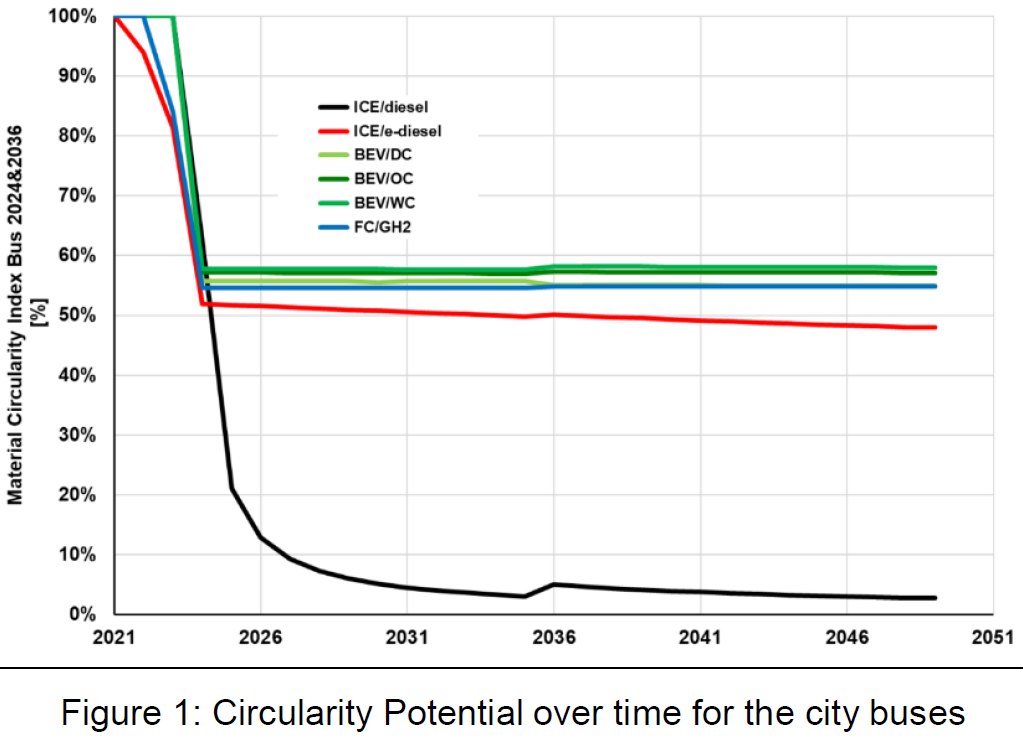
In the IEA Technology Collaboration Program experts from 20 countries focus on LCA of EVs since 2010. The IEA Task 46 developed a new methodology to assess the Circularity Potential using a dynamic LCA approach and applied it in a case study to city buses using electricity, hydrogen, diesel and e-diesel. For LCA Circularity is define by Task 46: A product or service is “100% circular“, if its whole life cycle - production, operation and end-of-life - uses only reused components, secondary/recycled material, renewable energy and makes no waste and GHG emissions. The Circularity Potential is assessed based on the mass flows of the buses during their lifetime using data of the Inventory Analysis for the Material Circularity Index (MCI) - 100% = circular and 0% = linear – applying the Linear Flow Index of materials (LFImaterial) and the Utility Factor of product (UFproduct). Figure 1 shows the Circularity Potential over 24 years life time for the city buses. All systems start in nature with an MCI of 100% before the construction phase. During the construction, phase the MCI decreases significantly, for e-fuel and H2 more than for electric city buses due to the higher demand of renewable power plants. In the operation phase the MCI for systems using renewable electricity nearly remains constant beside a small influence due to the spare parts and maintenance. For systems, using fossil energy the MCI is drastically reduced in the operation phase due to the non-circularity of fossil fuel combustion.