The increasing plastic waste accumulation in landfills and the environment has emerged as a critical global challenge. Among various strategies to address this issue, chemical recycling has gained attention for its ability to convert plastic waste into high-quality products. However, the development and adoption of any recycling technology depends on its long-term economic viability. Given that these processes compete with fossil-based products, achieving feasibility often requires large-scale operations and a multiproduct approach, both of which demand significant capital investment1,2. 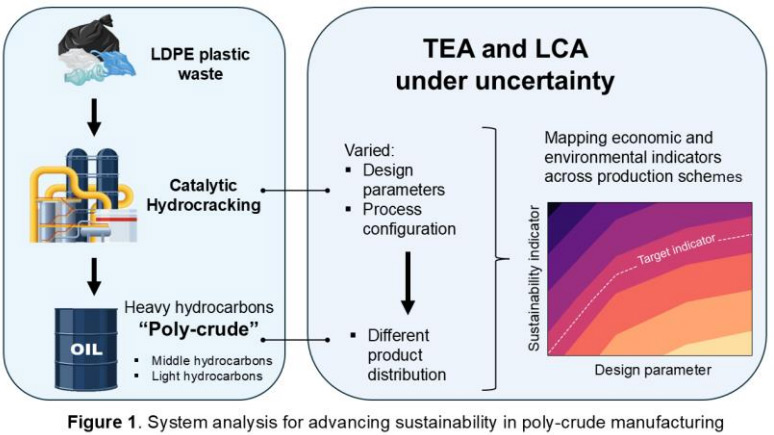
This project addresses these challenges by integrating plastic waste into the petrochemical supply chain, leveraging energy efficiency and the infrastructure of established petroleum processes to achieve significant cost savings. We focus on producing an energy-dense liquid, termed ‘poly-crude’ as a refinery feedstock, using catalytic hydrocracking. Hydrocracking yields high paraffinic hydrocarbons3,4, aligning with conventional refinery inputs. We aim to develop an agile techno-economic analysis (TEA) and life cycle assessment (LCA) of ‘poly-crude’ manufacturing to guide early-stage research and foster the development of sustainable solutions. Our previous results highlight that the process feasibility is highly sensitive to polycrude yield, reaction time, H2 handling costs, and plastic waste feedstock pricing. For instance, achieving yields above 90% with reaction times below 1 h reduces the minimum selling price of poly-crude (MSP) from $121.45/bbl to $97.32/bbl. These results were obtained assuming the production of poly-crude and light hydrocarbons (C3-C4). To broaden the scope, we evaluate alternative production schemes, such as producing middle distillates as co-products, which could enhance revenues and reduce hydrogen demand, identified as a key economic driver. Multiple process configurations are simulated using Python, with economic feasibility assessed through discounted cash flow analysis based on an nth plant design. Environmental impact is assessed using indicators such as the energy rate of return and greenhouse gas emissions. By linking product distribution, design parameters, process configurations, and economic and environmental indicators, this study identifies critical parameters and product considerations to advance in integrating plastic waste into the petrochemical value chain.