CiCLO® technology is a textile innovation that enables polyester made from recycled inputs to remain highly durable during its useful life, biodegrade when it inevitably pollutes the environment in the form of microplastics, and maintain recyclability.
Polyester is the preferred fiber for 57% of textiles, accounting for 71 million tonnes (MT) in 2023, up from 63 MT in 2022. Of the 71 MT, only about 8.9 MT were from recycled materials—98% from PET chips and 2% from textile waste. Volumes of recycled polyester are expected to grow, especially from textile waste, which our planet is abundant of today. EPR legislation requiring textiles to be recycled, combined with tremendous investment in collection and sorting infrastructures and recycling technologies, will exponentially increase the percentage of polyester produced from textile waste. These circular systems for textiles are beneficial for the planet, but polyester, a non-biodegradable plastic, persists in the environment indefinitely as pollution, regardless of the raw materials used.
Considering the extensive use of polyester and its non-biodegradable nature, it correlates that fiber fragmentation from synthetic textiles (referred to as “microfiber pollution”) is the most prevalent form of microplastic pollution accumulating in all environments globally. Fiber fragments are so small that they unavoidably leak into the environment through many pathways, where they cannot feasibly be recaptured. The accumulation of this form of microplastic pollution is an environmental threat impacting biodiversity loss and climate change.
Source reduction, design for less shedding, and filtration are important primary mitigation measures, but only partial solutions and sometimes impossible or cost-prohibitive to implement. Polyester, largely from recycled textile inputs, will continue to be an important material for the textiles industry into the foreseeable future, and microplastics that shed from them will continue to pollute and accumulate in the environment at alarming rates.
For these reasons, textile veterans invented CiCLO® technology to enable polyester to remain durable and recyclable, yet inherently biodegradable. The inventors’ approach, covered in this paper, proves:
- durability of fiber maintained
- complete mineralization of recycled polyester made with CiCLO® technology in aerobic and anaerobic conditions at a range of temperatures using internationally recognized ASTM and ISO respirometry test methods
- non-toxicity to marine and plant life
- evidence of no microplastics left over
- fiber traceability
- fabric recyclability
- compatibility within existing batch and continuous polymerization manufacturing processes
CiCLO® polyester is used by major brands and retailers across textile categories including apparel, home textiles, uniforms, cleaning supplies and more.
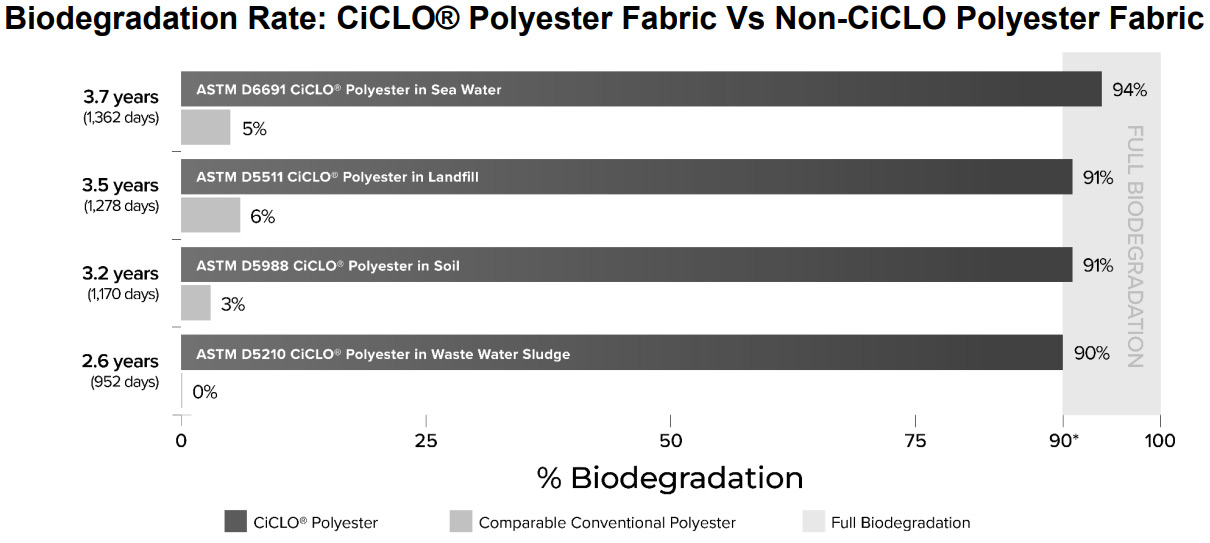
The chart above represents a summary of data from long term studies at 3rd party labs comparing the biodegradation rate of a polyester fleece fabric made from recycled PET yarn that has been sold at retail for many years (identified as “Comparable Conventional Polyester”) and the fabric recreated with the same specs except that the recycled PET yarn incorporated CiCLO® technology (identified as “CiCLO® Polyester”). The CiCLO® polyester fully biodegraded within 952 to 1,362 days depending on the environment, as compared to zero to 6% biodegradation of the polyester without CiCLO® technology. Rate of biodegradation in uncontrolled open environments will vary based on many factors. Achieving ≥90% in respirometry is recognized as full biodegradation. The remaining percentage can be attributed to biomass. Further analysis has been conducted to confirm no microplastics leftover.